
Daily Jigsaw Puzzles
Big Cake AppsTrivia
4.8633.00 Reviews
- Version
- 1.5.102
- Installs
- 1.00M
- Age Rating
- Everyone
Screenshots
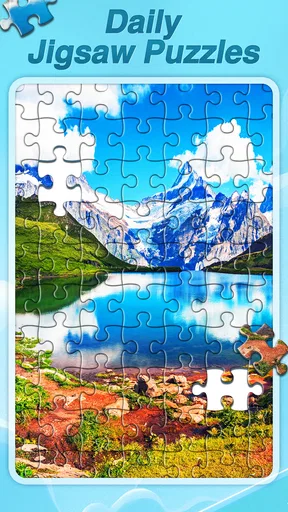

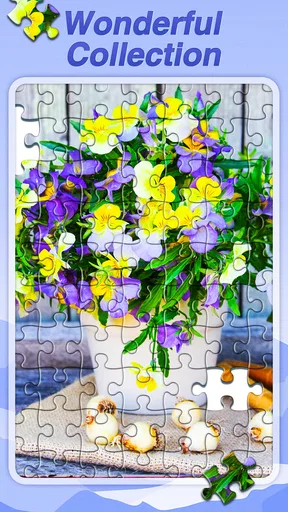
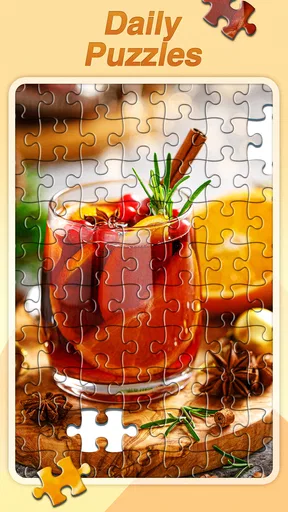
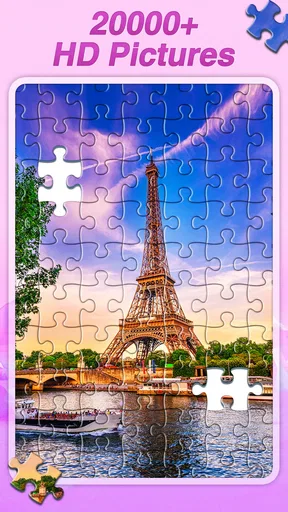
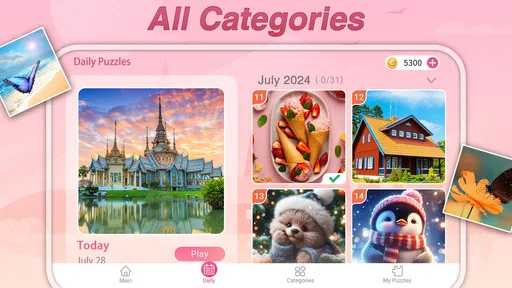
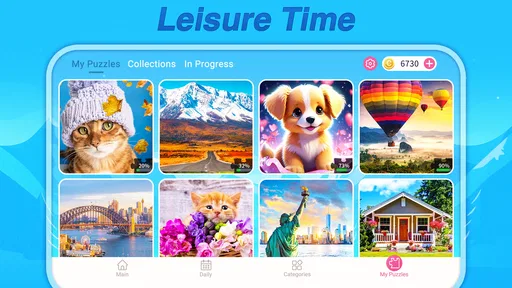
Our Review of Daily Jigsaw Puzzles
 Analysis by Appyee
Daily Jigsaw Puzzles is the kind of trivia game I open when I want something quiet rather than competitive. It turns the familiar jigsaw format into a large collection of digital puzzles, with more than twenty thousand HD images aimed at adults. I found the appeal less in chasing a score and more in having a flexible activity for a short break, a slow evening, or a moment when I wanted my attention occupied without a complicated rule set.
The game is free, and that matters when deciding whether it fits your routine. I could approach it casually instead of treating it like a purchase that needed to justify itself. Big Cake Apps is the developer, and the game has built a strong audience: it has passed one million installs, carries a 4.7 average from around 9.2 thousand ratings, and includes 617 written reviews. Those figures suggest that the basic idea works for many people, although popularity alone does not tell me whether its style will suit every puzzle fan.
It is listed for Everyone and runs on Android 6.0 or later. The release date was January 2, 2024, while the current version is 1.4.4. In practical terms, that makes it accessible to people using older compatible Android devices as well as newer phones and tablets. I would still check the available storage and device comfort before committing to long sessions, because a puzzle is much more pleasant on a screen where individual pieces are easy to see.
How the puzzle routine feels in everyday use
I find the routine easiest to enjoy when I treat each session as a small, self-contained pause rather than a project I have to finish. Choosing an image that suits the time I have—clear shapes for a brief break, finer detail when I can settle in—helps keep the puzzle relaxing. That everyday rhythm also makes it worth considering what happens when I use the game more heavily.
A calm format that works in small pieces
The strongest part of the experience is how easy it is to begin. A traditional jigsaw requires a table, a box, and enough uninterrupted space to leave the work in place. This digital version removes that preparation. I can pick it up for a few minutes, put it down, and return later without clearing a dining table or worrying about a pet moving pieces around. That makes it especially suitable for commuting, waiting rooms, or a quiet pause between household tasks.
There is also a useful difference between solving a digital puzzle and playing a conventional trivia title. I am not being asked to remember facts, react quickly, or compete against another player. The mental effort comes from recognizing colors, edges, shapes, and visual patterns. For me, that creates a more forgiving kind of concentration. A wrong placement is not a failure that ends a round; it simply gives me another small problem to work through.
The image collection is central to the experience. With such a broad selection, the game is better suited to changing moods than a small fixed pack would be. I might prefer a bright landscape one day and a more detailed scene the next. The promise of variety is valuable because repetition is one of the quickest ways for any puzzle app to lose its charm.
Still, a large image library can create its own problem: choice can become a delay. When I have too many possibilities, browsing may take almost as much attention as solving. My practical approach is to choose a picture quickly based on its overall composition instead of searching for a perfect subject. A scene with clear color blocks is a good starting point when I want a relaxed session; a detailed image is better when I want the puzzle itself to occupy me for longer.
What makes the HD presentation useful
The HD presentation is not just a decorative label in this type of game. Fine visual detail affects how satisfying the puzzle feels, particularly when several pieces share similar colors. A sharp image gives me more information to work with, while a soft or muddy picture can make the task feel arbitrary. On a phone, I tend to zoom my attention into one area at a time rather than trying to understand the complete image at once.
That approach also helps with crowded pictures. I start with obvious boundaries, strong contrast, or recognizable objects, then gradually connect the less distinctive sections. It is a simple workflow, but it prevents me from scattering pieces mentally across the whole board. The game becomes more manageable when I treat it as a series of small visual zones rather than one giant image.
There is a trade-off here. A detailed picture can be beautiful and rewarding, but it may be less comfortable on a small display. If I were choosing between a phone and a tablet, I would favor the larger screen for complex images and longer sessions. The phone remains convenient for quick play, yet convenience and visual comfort are not always the same thing.
Progress without turning relaxation into a chore
My favorite way to use this game is as a low-pressure ritual. For example, after dinner I can spend ten minutes completing a small portion of a picture instead of opening a social feed. The activity gives my hands and eyes something specific to do, but it does not demand the emotional energy of a competitive game. That makes it a reasonable choice for someone who wants a screen-based wind-down rather than another source of stimulation.
At the same time, I would not describe every session as equally relaxing. If I choose an image with many nearly identical areas, the search can become tedious. The trick is to notice when the puzzle has stopped feeling restorative. Switching to a simpler composition is usually better than forcing myself to finish a difficult one just because I started it.
This is one of the less obvious strengths of a digital jigsaw format: difficulty can be managed through image selection, not only through a formal setting. A beginner can choose an image with distinct sections, while an experienced solver can deliberately select a scene full of texture and subtle transitions. That gives the collection more practical range than the brief description might suggest.
Spending, access, and what I would check first
The game is free, so the initial decision is straightforward: I can install it and see whether the puzzle flow suits me without paying upfront. That is a meaningful advantage over buying a physical puzzle that may not match my taste, or purchasing a fixed digital pack before knowing how often I will use it.
However, free does not automatically mean every part of the experience is equally open. I would pay attention to any purchase prompts, locked content, or interruptions that appear during normal use before deciding whether it deserves a permanent place on my device. The confirmed information establishes that the game costs nothing to download, but it does not establish a complete purchase structure. I would therefore avoid assuming that every image, option, or convenience is included at no cost.
That uncertainty is worth handling calmly rather than treating it as a flaw by itself. A person who only wants occasional puzzles may be perfectly happy with the free path. Someone planning to use the game every day should inspect the actual in-app experience and decide whether any optional spending feels fair for the amount of use they expect. I prefer that approach to judging a free game solely by its download label.
There is also a practical spending advantage even when I never buy anything: digital puzzles do not require replacement pieces, storage boxes, or a dedicated surface. That does not make the app universally better than physical puzzles, because physical pieces offer a tactile experience the screen cannot reproduce. It simply means the value comparison depends on what I want from the hobby. For portability and instant access, the app has the clearer edge; for texture and shared table time, a physical set remains more satisfying.
Fairness when there is no traditional competition
Daily Jigsaw Puzzles is best understood as a personal puzzle activity rather than a contest. That changes how I think about fairness. I am not looking for an even matchmaking system, a balanced character roster, or a level playing field between players. The important question is whether the game lets me solve pictures on my own terms without creating pressure to spend in order to feel successful.
Because the core task is visual assembly, the fairest experience is one where progress depends mainly on patience and observation. The format naturally supports that: I can work through a difficult area at my own pace instead of losing because another player is faster. For people who dislike timers and leaderboards, that absence of direct rivalry is a major reason to choose this kind of game over mainstream trivia competitions.
There is a different kind of fairness issue around access. If attractive or easier images are separated from the free selection, the emotional effect can be stronger than the monetary cost alone. A puzzle app is supposed to feel like a break, so repeated pressure to unlock the most appealing content could undermine its purpose. I would judge the game by how often it lets me solve something enjoyable without nudging me toward a purchase.
I also would not compare its audience ratings directly with the score of a competitive quiz game. A 4.7 average from around 9.2 thousand ratings is encouraging, but people may be rewarding different things: calm pacing, image variety, accessibility, or simply the pleasure of completing a picture. The rating tells me that the concept is well received, not that it will satisfy someone seeking head-to-head trivia or a deep achievement system.
Who will enjoy it, and who should choose something else
I would recommend this game to adults who enjoy visual organization, want a gentle pastime, or need an activity that can be paused easily. It is also a sensible option for someone who likes the idea of jigsaw puzzles but lacks the room to keep a physical one in progress. The Everyone age rating makes the format broadly approachable, although individual preferences still matter more than the label.
It is less suitable for players who want factual questions, fast rounds, social competition, or a strong sense of character progression. Despite being placed in the trivia category, this is not the right pick if your idea of trivia means answering questions about history, sport, films, or science. The challenge is visual rather than knowledge-based.
I would also steer away from it if tactile feedback is the main reason I enjoy puzzles. Dragging pieces on glass cannot fully recreate the click and resistance of cardboard pieces. Likewise, a person who needs a highly structured campaign with clearly escalating objectives may find a large image library less motivating than a level-based puzzle game.
Small techniques that improve the experience
One useful habit is to separate “easy to recognize” from “easy to assemble.” A picture may have a clear subject but still contain a difficult background. I start with the areas that have strong contrast, then use those completed sections as visual anchors for nearby pieces. This reduces the time spent testing random shapes and makes detailed images feel less overwhelming.
Another tip is to stop treating every unfinished puzzle as a commitment. If I lose interest, I would rather switch images than turn relaxation into an obligation. The broad collection makes that possible, and it is one of the reasons the game works better as a daily choice than as a single long project.
For a shared household device, I would also agree on a simple routine before starting: use a larger screen when possible, keep the brightness comfortable, and avoid beginning a complicated image when only a minute is available. Those choices sound minor, but they determine whether the game feels like a pleasant break or a fiddly task.
The unknowns I would keep in mind
The confirmed information gives me a clear picture of the game’s identity, audience, compatibility, developer, release, version, rating, install reach, and free entry point. It does not by itself answer every question a careful user may have about the day-to-day experience. I would personally inspect the current app screen for the exact puzzle controls, the way unfinished work is handled, and the visibility of any optional purchases before building a long-term routine around it.
I would also test it on the device I intend to use rather than assuming that the minimum operating-system requirement guarantees identical comfort everywhere. Compatibility tells me whether installation should be possible; it does not tell me how enjoyable detailed images will be on every screen size. That distinction is especially important for a visual game.
These are not reasons to dismiss it. They are sensible checks for any free app whose value depends on repeated use. The safest expectation is that the core appeal is a large library of digital jigsaws, while the finer details of access and convenience should be judged from the live experience rather than guessed.
My trust verdict after weighing the trade-offs
What I trust most about Daily Jigsaw Puzzles is the clarity of its basic purpose. It does not need a complicated premise to be useful: choose a picture, settle into the visual task, and enjoy the satisfaction of bringing it together. The large collection, HD focus, free entry, and broad Android compatibility make it easy to try, while the strong average rating and substantial install reach indicate that many people have found the format worthwhile.
My reservation is not about the puzzle idea itself. It is about the details that can decide whether a free game remains comfortable over time: how browsing is organized, how often interruptions appear, and whether optional spending feels genuinely optional. Since those points should be judged from the current version rather than invented, I would treat the first session as a practical trial. If I can choose an appealing image and settle into solving without feeling pushed, the game earns my recommendation.
My final view is simple: this is a good choice for quiet, flexible puzzle time, not for competitive trivia. I would install it when I wanted a portable alternative to a physical jigsaw and a calmer substitute for faster mobile games. I would skip it if I needed tactile pieces, social rivalry, or question-based knowledge tests. For the right player, Daily Jigsaw Puzzles offers an approachable way to turn a few spare minutes into focused downtime, with enough visual variety to remain useful beyond a single casual session.
In the end, Daily Jigsaw Puzzles succeeds because it respects the simple pleasure of solving an image at my own pace. Its best use is not as a demanding game I must master, but as a dependable activity I can return to when I want my attention gently occupied. That makes it worth trying for adults who value calm, portability, and choice, provided they make their own judgment about the live free experience before investing heavily in it.
Privacy and Permissions
See what permissions an app requests and how it handles your data.
- Photos/Media/Files
- read the contents of your USB storage, modify or delete the contents of your USB storage
- Storage
- read the contents of your USB storage, modify or delete the contents of your USB storage
- Wi-Fi connection information
- view Wi-Fi connections
- Other
- view network connections, full network access, control vibration, prevent device from sleeping
Verdict
Strengths of Daily Jigsaw Puzzles
- New puzzles are available every day, keeping the experience fresh.
- Multiple difficulty levels suit both casual players and puzzle fans.
- Completed puzzles can provide a relaxing break from daily routines.
- Simple controls make placing and moving pieces easy on mobile screens.
- Progress can be enjoyed at your own pace without time pressure.
Limitations of Daily Jigsaw Puzzles
- Some puzzles may feel repetitive if you play several in one session.
- Small pieces can be difficult to handle on compact phone displays.
- The app may require an internet connection for new daily puzzles.
- Frequent players may find the challenge limited after mastering the basics.
- Puzzle completion can take considerable time on higher difficulty levels.
Other Releases by Big Cake Apps
View All
Classic Solitaire
Card4.7
Similar Picks in This Category
View All
Millionaire 2026 Quiz & Trivia
Quiz & Trivia Games by Submarine Apps4.5

Brain Test 2: Tricky Stories
Unico Studio4.7

Trivia Crack: Brain Quiz Games
etermax4.4

QuizzLand. Quiz & Trivia game
Quiz & Trivia Games by Mno Go Apps4.8

Brain Test: Tricky Puzzles
Unico Studio4.7

Logo Quiz
bubble quiz games4.5
Frequently Asked Questions
What is Daily Jigsaw Puzzles?
Daily Jigsaw Puzzles is a mobile puzzle game that offers a new selection of jigsaw images to complete each day. Players can choose from different themes, assemble pieces by matching shapes and colors, and gradually build finished pictures. It is designed for casual play, making it suitable for short sessions as well as longer, more relaxing puzzle breaks.
Is Daily Jigsaw Puzzles free to download and play?
The game can generally be downloaded for free, allowing users to try its basic puzzle content without an upfront purchase. However, free versions of puzzle apps may include advertising, optional in-app purchases, or locked image collections. Before downloading, check the store listing for the current pricing model, available features, and whether additional puzzle packs require payment.
Does Daily Jigsaw Puzzles work without an internet connection?
Some puzzles may be available offline once they have been downloaded, but the exact offline functionality can depend on the version of the app and the device being used. Internet access may still be required for daily updates, advertisements, account synchronization, or downloading new images. If offline play is important, test the game after loading a puzzle while connected.
What difficulty levels and customization options are available?
Daily Jigsaw Puzzles typically lets players adjust the challenge by selecting different numbers of pieces or choosing puzzles with more detailed images. Easier layouts are useful for beginners and quick sessions, while larger piece counts provide a more demanding experience. Depending on the version, users may also find options such as piece rotation, backgrounds, hints, or progress controls.
Is Daily Jigsaw Puzzles suitable for children and families?
The simple matching gameplay makes Daily Jigsaw Puzzles approachable for many children, teenagers, and adults, and it can be an enjoyable family activity. Nevertheless, parents should review the app’s age rating, advertising, in-app purchase settings, and privacy information before allowing younger players to use it. Difficulty and image themes should also be selected according to the child’s age and experience.
Play our best games!


